On the 17th of August we met with Peter Cusack at his home in North London to interview him about his life’s work on “sonic journalism”. Armed with nothing more than an old Sound Devices 633 recorder, two Sennheiser MKH-40 microphones, two XLR cables and a pair of headphones, a makeshift interview was undertaken in Peter’s living room with the windows open and street noises entering freely.
Sonic Journalism – An Interview with Peter Cusack
As soon as Karl entered Peter’s home, a conversation immediately started up that was centred around Peter’s work on field recording practices and documenting environmental issues. As such, Karl unfurled the XLR cables and set up the recorder and microphones as quickly as possible to begin recording. What came about was a very spontaneous, relaxed and informally-open interview, with Peter doing much of the talking, expounding on his experiences as a sonic journalist over the years, how he came to coin the term “sonic journalism”, and the interconnectedness of the stories around the environmental disasters in the areas he had recorded in: namely Chernobyl, the modern world’s oldest oil fields around the Caspian Sea, and the areas and communities affected by Aral Sea disaster.

Peter at his London residence.
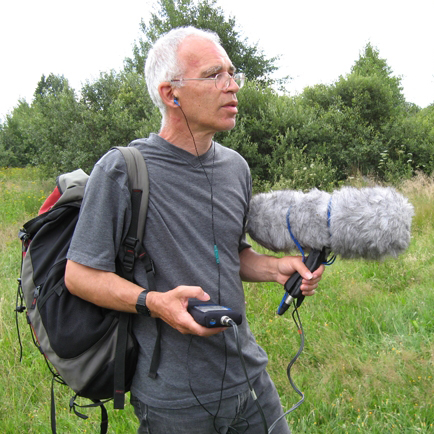
Peter recording in the Chernobyl exclusion zone.
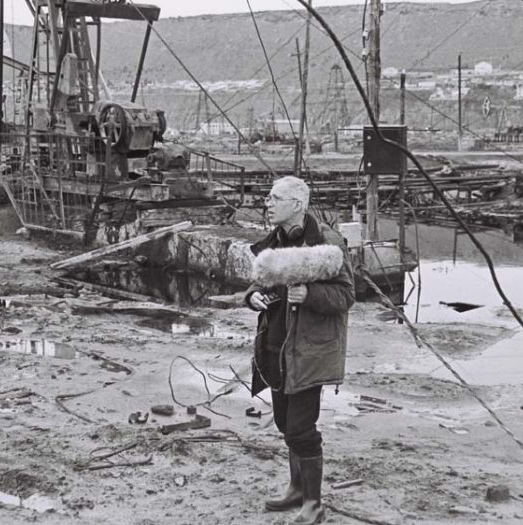
Peter recording at the Caspian Sea oil fields.
The interview is currently being edited here at The Orange Hut, with an aim to submit it to Resonance FM for consideration to air. Thus, nothing further will be mentioned about it here. That said, having a very serious interest in field recording practices… And in lieu of a forthcoming project that will look at elaborating on and developing ideas behind some of Peter’s work, it feels important to reference an article that he wrote in June 2011, entitled “Field Recording as Sonic Journalism” (Cusack, 2011). This article is worthy of note for two particular reasons. One, it looks at how the nomenclature “sonic journalism” came about through making a comparison to a well established and highly regarded mode of journalism called “photojournalism”. It also discusses what “sonic journalism” is, and lays out the basis for the recognition of this type of journalistic approach as an equally important, if somewhat overlooked, form of journalism.
*
What is sonic-journalism? In radio news, current affairs and sound documentary, as on TV despite the significance of images, the dominance of speech – spoken reportage, interviews, commentary, discussion – is unquestioned. Sonic–journalism is based on the idea that all sound, including non–speech, gives information about places and events and that listening provides valuable insights different from, but complimentary to, visual images and language. This does not exclude speech but re–addresses the balance towards the relevance of other sounds. In practice field recordings become the means to achieve this. Recordings can, of course, be used in many ways. In my view sonic–journalism occurs when field recordings are allowed adequate space and time to be heard in their own right, when the focus is on their original factual and emotional content, and when they are valued for what they are rather than as source material for further work as is often the case in sound art or music. Sonic-journalism can be specifically created or can refer to these qualities in recordings originally made for other purposes, such as ‘Starry Night’.
What do field recordings offer in this context? Most obviously they give basic information about places and events by virtue of the sounds, and their sources, we identify. Language and visual images also give such information. Indeed it is arguable they do so rather more explicitly than sound. The interpretation of sound certainly benefits from a knowledge of context in the same way that captions and titles enhance photographs. However field recordings convey far more than basic facts. Spectacular or not, they also transmit a powerful sense of spatiality, atmosphere and timing. This applies even when the technical quality is poor. These factors are key to our perception of place and movement and so add substantially to our understanding of events and issues. They give a compelling impression of what it might actually be like to be there. Sound is our prime sense of all–around spatiality and listening gives us a point of ear. It enables us to judge how far we are from the events and to ask how we might feel and react in the circumstances. Certainly, with recordings and broadcasts we know we are not there, but even at this reduced level there is a subjective engagement and intuititive understanding that, in my view, are field recordings’ special strength. Such elements allow sonic–journalism a significant impact qualitatively different from visual images or language.
*
For anyone wishing to explore Peter’s work further, the majority of his back catalogue can be found here on Bandcamp.
Many thanks to Peter Cusack for taking time out of his busy schedule to expound on the ideas and reasoning behind why he chose to coin the term “sonic journalism”, and for his detailed and jocular renditions about the subsequent discoveries he stumbled upon during his journalistic endeavours.
Bibliography
CUSACK, P. (2011) Field Recording as Sonic Journalism. UAL Research Online. [Online] Available at: https://ualresearchonline.arts.ac.uk/id/eprint/9451/1/Cusack%2C%20Sonic%20Journalism.pdf. [Accessed: 19th April 2016]