At the start of October each year, the high mountains and forests of the Ariege region in the Pyrenees plays host to one of the most impressive events of the wildlife calendar – the Red Deer rutting season.
CAMP Fr – Field Recording: Red Deer Season with Chris Watson
Over the last four years, CAMP Fr has hosted a special event that welcomes in the autumn and allows keen listeners and wildlife sound recordists to experience this phenomena: a course entitled “Field Recording: Red Deer Season with Chris Watson”. For those who don’t know, Chris Watson is the well known sound recordist who’s worked on many BBC natural history documentaries, and is the honorary president of the Wildlife Sound Recording Society in the UK. Chris also is a key member of Cabaret Voltaire (a UK based band that developed into one of the most prolific and important groups to blend pop with dance music, techno, dub house and experimental electronic music), and he was also part of the Halfer Trio at one point. This year, several places became available on this course at the very last minute, and so the studio decided to snap one up and send out a sound recordist to the south of France with assorted microphones to record the soundscape of the Pyrenees alive with the raucous calls of the male red deer rutting against one another, vying for as many hinds as possible.
Over the course of five days, dotted between some highly informative talks given by Chris about microphone recording techniques, microphone placement and perspective, microphone types, and field craft, a group of 14 people ambled around the vicinity of the quite commune of Aulus-les-Bains in the Pyrenean foothills, and made several recordings of the rut in full swing. While the spots we visited were chosen due the success of recordings made during the preceding years, many were not located in ideal areas, with busy roads nearby, or littered with mountain goats (and horses) and the continuous cacophony of their bells.
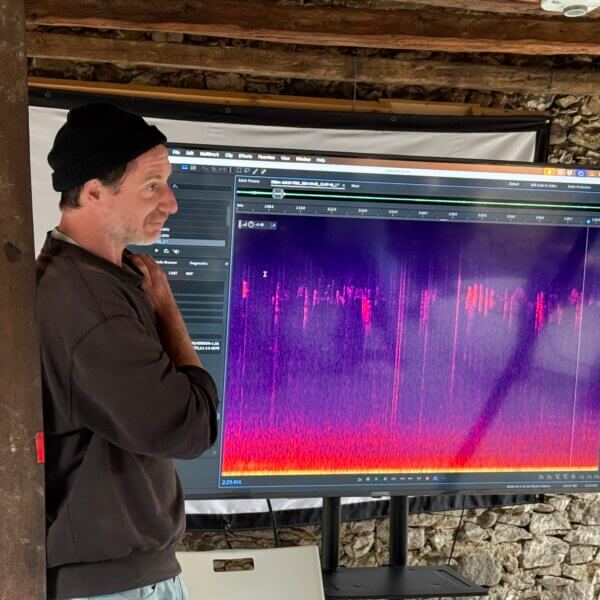
Andrew Bailey at CAMP Fr HQ talking about his work with Oxford University, investigating if sound and vibration can be used to gauge soil health in agricultural land.
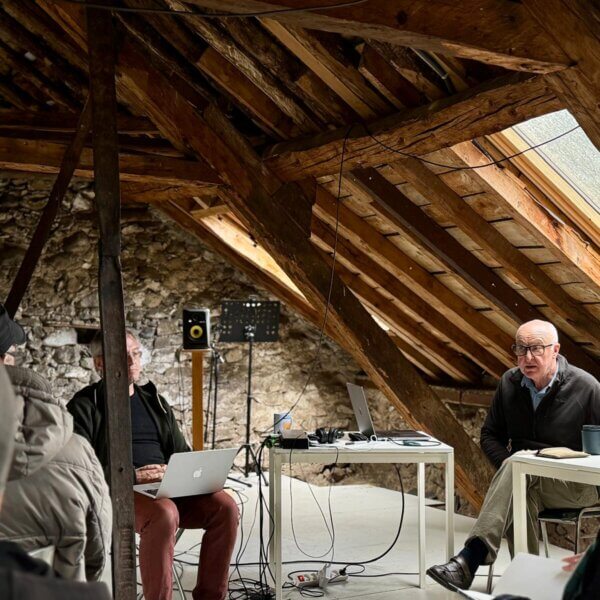
Chris Watson at CAMP Fr HQ discussing playback levels in various types of field recordings i.e. atmosphere, habitat, and species.
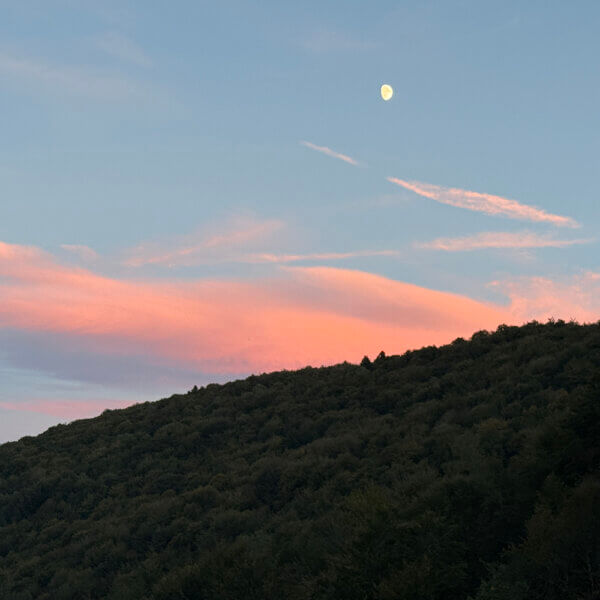
Sunset (and moon rise) at Le Bosc on the first night recording there with Chris Watson and nearly 18 members of the CAMP Fr group.
Due to the erratic movement of the deer through the forests and valleys around Aulus-les-Bains, which made their calls almost impossible to record in any detail, the CAMP Fr team decided to drive to a nearby place within the commune of Le Bosc, about an hour north of CAMP Fr HQ. This particular year the deer were exceptionally vocal at this spot and, set away from busy roads and wandering flocks of “belled” animals, the only other sound that would break through the lulls of the evening and night time roars were the airplanes passing overhead. Given these exceptionally fortuitous conditions, a handful of the CAMP Fr group decided to return to this site over the course of several afternoons, evenings and nights, to wander around various paths and tracks in the forest, in order to locate suitable vantage points from which to record the rut.
First Recording Session at Le Bosc
On the first night, eighteen people from CAMP Fr attended the site near Le Bosc.We arrived around 19:30, and walked (somewhat noisily) up past Le Colonne on Le Marrous, up in to the forest. While the deer were very vocal that night, they kept their distance from the group, so the recordings we made we more atmospheric or habitat in nature, as opposed to species specific. Some calls from tawny owls were even recorded off in the distance.
Second Recording Session at Le Bosc
A couple of days later a smaller group of four people (Kaija Siirala, Kristina Dutton, Andrew Bailey and Karl Richard) returned to the site and spent a longer time there in the evening. During this second visit the deer were much closer to the area from which our group was recording from (which was the same location as the first night’s visit), and Kaija captured nearby deer footsteps in her recording that couldn’t have been more than 20 meters or so away from her microphone.
Third Recording Session at Le Bosc
The Le Bosc site was visited a third time by two people (Mark Lipman and Karl Richard) and different parts of the commune’s area were explored. After arriving around 4:30pm, both Mark and Karl ventured deeper into the forest to try get closer to deers’ calls. However, a French gentleman (at Le Colenne, which was an old medical refuge in the 50s and 60s for patients with lung maladies) advised that they record closer to the road, as the deer remained relatively near to the river, which was usually within 50 meters of the roadway. That evening Mark and Karl followed the road and, listening to the deers’ calls from the car, found a suitable spot nearby the roadside from which to record. Mark recorded with an OTRF microphone array (utilising two Sennheiser MKH-8040s, and a central MKH-8040 microphone) and Karl made recordings with a Soundfield ST450 MKII ambisonic microphone. The recordings that night yielded much better results than the preceding two nights, if only because the microphones were located much closer to the “action”.
Forth Recording Session at Le Bosc
On the 9th of October, three people returned to the same site near Le Bosc (Kristina Dutton, Mark Lipman and Karl Richard). Utilising the same method for locating the deer from the roadside as we had done on the third night, a suitable spot was found that placed the three recordists directly in the centre of the “action”. A three hour recording session was undertaken, Mark using a 5.1 surround rig (that consisted of three Sennheiser MKH-8040s for the centre, left and right, and two Sennheiser MKH-8020s for the rL and rR), while Kristina recorded with a Soundfield NT SF-1 ambisonic microphone and a Telinga stereo parabolic microphone array, and Karl with a Soundfield ST450 MKII ambisonic microphone. The results of the fourth evening were spectacular, to say the least. Deers surrounded our vantage point for the better part of the evening, and the unusually rare sound of antlers colliding in the distance was also captured.
On the 10th, Karl departed CAMP Fr HQ in Aulus-le-Bains and returned to the UK via La Boulaye monastery. The B format ambisonic recordings were then decoded (utilising the Røde ambisonic decoding pulgin) and mixed at the Orange Hut studio. A short mix of the recordings made can be heard below.
To hear the soundscape composition in its entirety (which is an hour and a half long), one can listen to it and/or purchase it here.
Would like to say a huge thank you to everyone who organised and helped run CAMP Fr this year: James, Sarah, Elliot, DD, Thom, Joe and anyone else behind the scenes… You make the experience a home away from home… Plus a very big thank you to Chris Watson for sharing all his work, knowledge, skills, advice, and even some of his gear (but not his headphones), along with his years of wisdom and heart-felt stories with everyone so openly during the course… Everyone has said it’s been a true pleasure and honour, as always. Plus many thanks to all the attendees: Mark Lipman (the multi-mic man from California), Katrina Dutton (the Soundfield girl-wonder), Rebecca Mahay (rave ambient queen), Robert Smith (from the New York Times), Andrew Bailey (the Rap God), Mike Challis, Jo Geddes (the platypus girl), Kaija Siirala, Rob Parton, Francesca de Buyl, Carla Santana (daughter of Carlos Santana, maybe?), Holly Fisher (of travel Podcast acclaim) and Jenn (the lady who educated me on Ireland’s historical gripe with England), for all being such solid, sound people who shared and cared about all aspects of the CAMP FR experience. You all helped make it such an amazing trip.